
Blog

Valium is a brand of diazepam, a prescription sedative in the benzodiazepine family. Doctors use it for anxiety and alcohol withdrawal, and alongside other treatment for muscle spasm and some kinds of seizures.
The FDA approved Valium in 1963, and it was one of the best-selling drugs in the U.S. through the 1970s. Plenty of people had a parent or grandparent who took it, so it can feel like a mild, everyday pill. It isn’t one. Taken with alcohol or opioid painkillers, it can slow breathing to a dangerous level, and after a few weeks of daily use the body can come to depend on it.
What follows is general information. Your prescriber and pharmacist know your history and can tell you how it applies to you.
What Is Valium?
Valium is the brand name. Diazepam is the drug inside it. Generic diazepam tablets have the same active ingredient, and unless your prescriber asks for the brand, the pharmacy will usually fill your prescription with the generic.
Diazepam doesn’t only come as a tablet. Hospitals give it by injection. A rectal gel and a nasal spray, sold under other brand names, are prescribed for families to keep at home for seizure clusters. Everything in this guide is about the tablets.
Why you need a prescription
Diazepam acts on the brain strongly enough that it has to fit the person taking it. Someone with sleep apnea, or someone already on an opioid, faces very different risks from a healthy 40-year-old, and a prescriber checks for those things first. Federal law also lists diazepam as a controlled substance, which caps refills and, in many states, means each fill is tracked.
How it affects the brain, in short
Your brain has its own calming signal, a chemical called GABA. Diazepam makes nerve cells respond to it more strongly, so overall nerve activity drops. That’s why people on Valium often feel calmer and looser in the muscles, and it’s also why they get drowsy. Our article How Does Valium Work? Diazepam Mechanism Explained (internal link) covers this in more detail.
What Is Valium Used For?
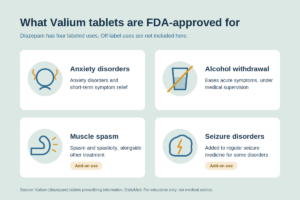
The FDA label for Valium tablets lists four uses. They’re quite different from each other, so a prescription for one says nothing about whether it’s right for another.
Anxiety disorders
Valium is approved for anxiety disorders and for short-term relief of anxiety symptoms. The label itself says the ordinary stress of daily life usually doesn’t need an anti-anxiety drug. Many prescribers keep benzodiazepines for short stretches or particular situations. For long-term anxiety care, they tend to rely on therapy or other medicines.
Acute alcohol withdrawal
When someone who has been drinking heavily for a long time suddenly stops, they can go into withdrawal. That can mean shaking, sweating and agitation, and in the worst cases hallucinations or delirium tremens. Diazepam can calm those symptoms. This treatment happens under medical care, because severe alcohol withdrawal can kill.
Muscle spasm (add-on treatment)
For muscle problems, Valium is an add-on, used together with other treatment such as physical therapy. The label covers spasm from a local injury or from inflamed muscles and joints. It also covers spasticity from conditions that affect the brain or spinal cord, such as cerebral palsy or paraplegia, and it lists athetosis and stiff-person syndrome.
Seizure disorders (add-on treatment)
Oral Valium can be added to a person’s regular seizure medicine for some convulsive disorders. It’s rarely used on its own for long-term control. The rectal gel and nasal spray mentioned above are separate products for stopping seizure clusters.
Off-label uses
Prescribers also use diazepam for things that aren’t on the label, like calming someone before an MRI or dental work, or treating some types of vertigo. That’s called off-label use. It can be reasonable, but the FDA hasn’t approved these uses, and the decision rests on the prescriber’s judgment for that patient.
Is Valium a Benzodiazepine?
Yes. Diazepam was one of the first benzodiazepines. It was developed at Roche by Leo Sternbach, the same chemist who created Librium. The class also includes alprazolam (Xanax), lorazepam (Ativan) and clonazepam (Klonopin). All of them strengthen the brain’s GABA signal. They differ in how fast they start, how long they last and which uses the FDA has approved.
Most other anxiety medicines work a different way. SSRIs such as sertraline and SNRIs such as venlafaxine act on serotonin and norepinephrine and take a few weeks to help. Buspirone is another option. Each has trade-offs, and your prescriber is the right person to weigh them against your history.
Is Valium a Controlled Substance?
Yes. Diazepam is in Schedule IV of the federal Controlled Substances Act. The DEA puts a drug in Schedule IV when it has accepted medical uses but can still be misused and cause dependence. Schedule IV drugs carry less risk than Schedule II drugs such as oxycodone.
In practice, a Schedule IV prescription can be refilled no more than five times, and not past six months from the date it was written. Most states run prescription monitoring programs, so your pharmacist and prescriber can see other controlled medicines you’ve filled. Giving or selling your pills to someone else is a crime, even if that person has the same symptoms.
Is Valium Addictive?
It can be. Four terms come up when people talk about this, and each one means something different.
Physical dependence means your body has adjusted to the drug and reacts when it’s taken away. This can happen even when you take Valium exactly as prescribed. Higher doses and longer use make it more likely.
Tolerance means the same dose starts doing less. People usually notice this first with sleepiness.
Misuse means taking it in a way it wasn’t prescribed: more pills, more often, or to get a feeling rather than treat a symptom.
Addiction, also called substance use disorder, means someone keeps using despite harm, has cravings and struggles to cut back. A personal or family history of substance use raises the risk, but addiction can happen to anyone.
In 2020 the FDA added a boxed warning, the strongest kind it uses, to every benzodiazepine label. It covers all four of these, plus withdrawal. Having a prescription doesn’t make these risks go away. It means your prescriber thinks the benefit is worth the risk for you, and it’s a good reason to keep your follow-up appointments.
Why stopping suddenly is dangerous
After regular use, stopping all at once or cutting the dose fast can bring on withdrawal. Anxiety and insomnia often come back stronger than before, along with irritability, shakiness and sweating. The most serious risk is seizures. Some people have symptoms that drag on for weeks or months.
Diazepam leaves the body slowly, so withdrawal might not start until several days after the last pill. That delay can fool people into thinking they’re fine. Talk to your prescriber before you stop or lower your dose so they can plan a slow taper with you.
Common Valium Side Effects
The label lists drowsiness, tiredness, muscle weakness and ataxia (unsteady, clumsy movement) as the most common side effects. They’re usually strongest in the first few days, or right after a dose goes up.
Other side effects people report include:
- Confusion or foggy thinking
- Trouble remembering what happened after a dose
- Dizziness
- Blurred or double vision
- Slurred speech
- Headache
- Constipation or nausea
- Changes in sex drive
Most of these are mild, and some people get none of them. Older adults feel them more, especially the unsteadiness and confusion.
Now and then, diazepam does the opposite of what’s expected and causes agitation, restlessness, anger or sleeplessness. Doctors call these paradoxical reactions. They’re rare and show up more often in children and older adults. Tell your prescriber if this happens to you.
Serious Valium Risks and Warnings
Most serious problems come back to one fact: diazepam slows the nervous system, and other substances can push that slowing too far.
Taking it with opioids
Valium taken with an opioid can slow breathing enough to cause coma or death. Opioids include oxycodone, hydrocodone and codeine cough syrup. This combination is the first item in the boxed warning. Prescribers only combine the two when nothing else works, and then at the lowest doses for the shortest time.
Deep sedation and breathing problems
Diazepam can cause deep sedation even on its own. People with lung disease or breathing problems are at greater risk. The label rules it out for anyone with severe respiratory insufficiency or sleep apnea syndrome.
Dependence and withdrawal
Regular use can lead to dependence, and stopping suddenly can cause seizures. The addiction section above goes through this.
Build-up and falls in older adults
Older bodies clear diazepam and its active by-product more slowly, and so does a damaged liver. With repeated doses, the drug can pile up and leave someone groggy, confused and more likely to fall. For this reason, the American Geriatrics Society’s Beers Criteria recommends that most older adults avoid benzodiazepines.
Driving and machinery
Your reaction time can be slower even when you don’t feel sleepy, and the effect can last into the next day. Wait until you know how Valium affects you before you drive or use machinery.
Depression and mood changes
Benzodiazepines can make depression worse. If you’ve had depression or thoughts of harming yourself, tell your prescriber before you start.
Pregnancy and breastfeeding
When taken late in pregnancy, benzodiazepines can leave a newborn sleepy or in withdrawal. Diazepam also gets into breast milk. If you’re pregnant, trying to get pregnant or breastfeeding, talk through the risks with your prescriber.
Valium and Alcohol
Don’t drink while you’re taking Valium. Alcohol and diazepam both slow the brain. Together they can cause much deeper drowsiness, blackouts, falls and slowed breathing than either would cause alone.
No amount of alcohol is known to be safe with Valium. How badly the two interact depends on the dose, the timing, your body and whatever else you take. Diazepam also stays in your system for days, so a drink the evening after a dose still counts.
Using diazepam to treat alcohol withdrawal is a different situation. That happens under medical care, after the drinking has stopped.
Valium and Other Medications
Diazepam interacts with a long list of medicines. Some of them add their own sedation. Others change how fast your liver gets rid of diazepam.
Sedation adds up when diazepam is combined with:
- Opioids and other benzodiazepines
- Sleep aids like zolpidem
- Drowsy antihistamines like diphenhydramine
- Some antidepressants and antipsychotics
- Muscle relaxants
- Gabapentin and pregabalin
- Cannabis
The liver clears diazepam mostly through two enzymes, CYP3A4 and CYP2C19. Some antifungals, some HIV drugs and some acid reducers slow those enzymes and can push diazepam levels up. Rifampin and certain seizure medicines speed the enzymes up and can bring diazepam levels down.
These lists aren’t complete. Bring every prescription, over-the-counter product, vitamin and supplement you take to your pharmacist for a review, and check with them before you start anything new.
How Long Does Valium Stay in Your System?
Diazepam clears slowly. Its label gives an elimination half-life of up to 48 hours. As the liver breaks it down, it makes desmethyldiazepam (also called nordiazepam). That by-product is also active, and its half-life can reach 100 hours.
Half-life is how long it takes for the level in your blood to drop by half. It takes several half-lives for most of a drug to leave the body, so diazepam can stay around for days. In older adults and people with liver disease, it can take longer still.
You won’t feel it that whole time. The effect of one dose usually fades within hours. With daily use, though, the drug and its by-product build up. Some people feel more sedated over the first week or so, not less.
For more on how quickly it starts and how long the effects last, see How Does Valium Work? Diazepam Mechanism Explained (internal link).
Who Should Talk With Their Doctor Before Taking Valium?
Give your prescriber your full health history before you start. According to the label, Valium shouldn’t be used by people with:
- A known allergy to diazepam
- Myasthenia gravis
- Severe respiratory insufficiency
- Severe liver impairment
- Sleep apnea syndrome
- Acute narrow-angle glaucoma
It’s also not given to babies younger than 6 months.
The following don’t automatically rule Valium out, but your prescriber needs to know about them:
- You take opioids, sleep medicines or other sedating drugs
- You or a family member have a history of alcohol or drug misuse
- You’ve had depression or thoughts of self-harm
- You have lung disease, kidney disease or milder liver problems
- You’re 65 or older
- You’re pregnant, planning a pregnancy or breastfeeding
- Your job or daily routine involves driving or heavy machinery
When Should You Seek Medical Help?
Call 911 or go to the nearest emergency room if someone taking Valium:
- Is very hard to wake or doesn’t respond
- Has slow, shallow or stopped breathing
- Has bluish lips or fingertips
- Has a seizure
- Has swelling of the face, lips or throat, or trouble breathing after a dose
These can be signs of overdose, especially when Valium was taken with opioids or alcohol. If opioids might be involved and you have naloxone, give it and call 911. Naloxone won’t reverse diazepam, but it can reverse the opioid.
If you think someone took too much but they’re awake and breathing normally, call Poison Control at 1-800-222-1222. Call 911 if they get worse.
Call your prescriber soon (it doesn’t need to be an emergency) if you notice any of these:
- New confusion
- Odd changes in mood or behavior
- Worsening depression
- A fall
- Withdrawal symptoms after a missed dose or a dose change
If you’re having thoughts of suicide, call or text 988 to reach the Suicide and Crisis Lifeline.
Frequently Asked Questions About Valium
What is Valium?
Valium is a brand-name prescription tablet containing diazepam, a benzodiazepine. It’s used for anxiety and alcohol withdrawal, and as an add-on treatment for muscle spasm and some seizure disorders.
What is diazepam?
Diazepam is the generic name for the drug in Valium. Generic tablets contain the same medicine and have to meet the same FDA standards for quality and absorption.
Is Valium a muscle relaxer?
It does relax muscles, and it’s approved as an add-on for muscle spasm and spasticity. It isn’t in the same class as muscle relaxants like cyclobenzaprine or methocarbamol, though. It’s a benzodiazepine, and it carries that class’s risks of sedation and dependence.
Is Valium a controlled substance?
Yes, it’s in Schedule IV. There are legal limits on refills, and most states track each fill.
Is Valium addictive?
It can cause physical dependence even when taken as prescribed, and some people develop an addiction. The risk rises with higher doses, longer use and a history of substance use.
Does Valium make you sleepy?
Yes. Drowsiness is its most common side effect. Because diazepam lasts so long, some people still feel slowed down the next day.
Can you drink alcohol while taking Valium?
No. The two together can cause deep sedation and slow breathing, and the risk doesn’t end when the calming effect wears off.
How long does Valium stay in your system?
Diazepam’s half-life is up to 48 hours, and its active by-product lasts up to 100 hours, so it can stay in your system for days or longer. Age, liver health and how long you’ve been taking it all affect this.
Can you stop taking Valium suddenly?
Not safely if you’ve been taking it regularly. Stopping suddenly can cause withdrawal, including seizures. Your prescriber can set up a gradual taper.
Is Valium the same as Xanax?
No. Both are benzodiazepines, but alprazolam (Xanax) starts and wears off faster and is approved for anxiety and panic disorder. Diazepam lasts much longer and is also approved for muscle spasm, alcohol withdrawal and seizures.
The Bottom Line
Valium can be a useful medicine when it’s prescribed for the right reason and taken as directed. It lasts a long time in the body, it doesn’t mix with alcohol or opioids, and regular use can lead to dependence. Keep your pharmacist informed about everything you take, and don’t change your dose without talking to your prescriber first.
Speak With Our Pharmacist
Have questions about Valium, diazepam, side effects, or possible medication interactions? Visit [Pharmacy Name] or speak with our pharmacist.
Medical Disclaimer
This article is for general education and isn’t medical advice. It doesn’t replace a visit with a licensed healthcare provider. Don’t start, stop or change any medication without talking to your prescriber. If you think you’re having a medical emergency, call 911.
Sources and References
- DailyMed: Valium (diazepam) tablets prescribing information:
- FDA: Boxed warning updated to improve safe use of benzodiazepine drug class (2020)
- MedlinePlus: Diazepam
- DEA: Benzodiazepines drug fact sheet
- DEA Diversion Control Division: Controlled substance schedules
- American Geriatrics Society: Beers Criteria
- Poison Control