
Blog

Valium works by boosting GABA, a chemical your brain uses to slow nerve signals down. The drug in Valium, diazepam, latches onto receptors on nerve cells and makes them react more strongly whenever GABA shows up. Nerve activity drops as a result.
Most of what Valium does comes back to that one action, whether it’s the calm someone feels during a panic spike or the grogginess the next morning. Below, we go through what happens in the brain and body, how soon the drug starts working, how long it lasts, and why stopping can be hard.
How Does Valium Work in the Brain?
Nerve cells talk to each other by releasing chemical messengers. Some messengers tell the next cell to fire. Others tell it to hold off. GABA (gamma-aminobutyric acid) is the brain’s main “hold off” messenger. You can think of it as the braking system for the brain and spinal cord.
GABA-A receptors
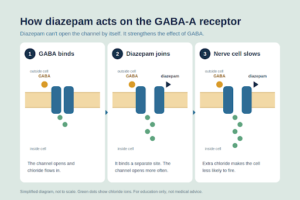
GABA works by landing on receptors on the surface of nerve cells. The most common one, the GABA-A receptor, is a tiny channel through the cell wall. When GABA binds, the channel opens and chloride ions flow in. Chloride carries a negative charge, and the extra negative charge makes it harder for the cell to fire.
Where diazepam comes in
Diazepam binds to a different spot on the same receptor, usually called the benzodiazepine site. It can’t open the channel by itself. It needs GABA to be there. What it does is make the receptor more responsive, so the channel opens more often each time GABA arrives.
Pharmacologists call this a positive allosteric modulator. In plain terms, diazepam turns up the volume on a signal your brain is already sending.
Older sedatives, the barbiturates, can force the channel open on their own at high doses, and diazepam can’t. That offers less protection than it sounds like, though. Alcohol and opioids each slow the nervous system in their own way. Add either one to diazepam and the combined effect can stop someone breathing.
Why one drug has several effects
GABA-A receptors come in many versions, built from different combinations of protein subunits, and different parts of the brain have different mixes. Diazepam acts on many of these versions. That’s why the same tablet a doctor prescribes for anxiety can also loosen muscles, help prevent seizures and make you sleepy.
Why it reaches the brain fast
Diazepam dissolves readily in fat. The brain contains a lot of fat, so once the drug is absorbed into the blood, it gets into brain tissue quickly.
What Does Valium Do to the Body?
GABA-A receptors are spread through the brain and spinal cord, so boosting GABA’s effect does more than one thing. The table below is a rough guide to which part of the nervous system is behind each effect. The real picture is messier, but it’s a useful starting point.
| What you might notice | What’s going on |
| Less anxiety or tension | The brain’s threat-detection areas quiet down |
| Muscles loosen | The spinal cord and brainstem send fewer “tighten” signals |
| Sleepiness | The systems that keep you awake slow down |
| Slower reactions, clumsier movement | The cerebellum, which fine-tunes movement, is affected |
| Gaps in memory after a dose | The hippocampus has a harder time storing new memories |
If you’ve been prescribed diazepam for anxiety or muscle spasm, the first two rows are what your prescriber is aiming for. The rest are side effects. Slower reactions matter if you drive. Memory gaps are why some people can’t recall conversations from the hours after a dose. At higher doses, or with alcohol or other sedatives on board, the same slowing can go further, into heavy sedation and slowed breathing.
How strongly this happens varies a lot from person to person. An 80-year-old with liver disease and a healthy 35-year-old can take the same dose and have very different days. Body weight, other prescriptions and how long someone has been taking diazepam also make a difference.
How Does Valium Help With Anxiety?
The amygdala is a small area deep in the brain that reacts to threats. In an anxiety disorder, it tends to fire even when there’s no real danger. It still sets off the body’s stress response: a racing heart, tight shoulders, and the feeling that you can’t sit still.
Diazepam turns down activity in those circuits. It also relaxes muscles, so the physical tension often eases along with the worry. Many people notice a change within about an hour. Antidepressants used for anxiety, such as SSRIs, work differently and usually take several weeks to help.
What diazepam doesn’t do is fix whatever is driving the anxiety. When a dose wears off, or when the medicine is stopped, symptoms can come back. That’s why many prescribers use it for short stretches or specific situations, such as the first weeks while an SSRI starts working. Therapy or a longer-term medicine then carries the load. The right mix is different for each person and is something to work out with your prescriber.
How Does Valium Relax Muscles?
Your muscles take their orders from nerve signals running through the spinal cord. With spasm or spasticity, some of those reflex circuits keep firing when they shouldn’t, so a muscle stays clenched or jerks without warning.
Diazepam adds extra braking in the spinal cord, which quiets those runaway reflexes. It also works on brain areas that help set muscle tone. For someone with a back spasm after an injury, or stiffness from a spinal cord condition, the muscles can loosen and hurt less.
The FDA approves Valium for muscle spasm only as an add-on, meaning it’s used alongside treatment like physical therapy, not in place of it. The same loosening effect can make legs feel weak or wobbly. In an older adult, that’s a real fall risk.
How Does Valium Help During Alcohol Withdrawal?
Alcohol works on the brain in two ways at once. It boosts GABA’s calming effect, and it blocks glutamate, the brain’s main “go” signal.
Drink heavily every day for months or years, and the brain adjusts to keep itself running. It turns its own GABA response down and its glutamate activity up. Then, if the drinking suddenly stops, the brakes are weak and the accelerator is still floored. The result can be shaking hands, drenching sweats, anxiety and a pounding heart. At worst, it’s seizures or delirium tremens.
Diazepam steps in for some of the GABA support the alcohol was providing, which steadies things while the brain readjusts. Because it lasts so long, its effect doesn’t swing up and down between doses. This is done under medical supervision, because alcohol withdrawal can be fatal and the dosing needs close watching. Drinking while taking Valium is a completely separate situation, and it’s dangerous.
How Does Valium Work for Seizures?
A seizure happens when a large group of nerve cells starts firing together in an uncontrolled burst. Normally, the brain’s braking signals stop that kind of runaway activity before it can take hold.
Diazepam strengthens those brakes, so abnormal activity has a harder time starting and spreading. Oral Valium is approved as an add-on to a person’s regular seizure medicine. Doctors rarely use it alone for long-term control, partly because the body can grow tolerant to its anti-seizure effect over months.
The rectal gel, the nasal spray and the injection work the same way. They’re separate products, made for stopping a seizure cluster or a seizure that won’t end.
How Long Does Valium Take to Work?
Diazepam is absorbed well from the stomach and gut. According to Valium’s prescribing information, blood levels usually peak 1 to 1.5 hours after a tablet, though it can be as quick as 15 minutes or as slow as 2.5 hours. Since the drug gets into the brain quickly, many people feel something within the first hour.
A heavy meal can slow absorption and push the peak back somewhat. Age, liver health and other medicines can shift the timing too.
If a dose doesn’t seem to be doing anything, don’t take another. Diazepam keeps climbing in your blood for a while after you swallow it, and a second dose on top can leave you heavily sedated. Call your pharmacist or prescriber instead.
How Long Does Valium Last?
This question has two answers, because how long you feel Valium and how long it stays in your body are separate things.
How long you feel it
After one dose, diazepam spreads out of the blood and brain into fat and muscle fairly quickly. That’s why the calm from a single tablet usually wears off within several hours, even though plenty of the drug is still in your body.
How long it stays in your body
The liver breaks diazepam down slowly. Its half-life can be as long as 48 hours. As it’s broken down, it turns into desmethyldiazepam, which is also active and has a half-life of up to 100 hours. Smaller amounts become temazepam and oxazepam, both active too.
This is why diazepam is called long-acting. Take it every day and the drug and its by-products pile up over several days before levels settle. Some people are surprised to feel sleepier in the first week rather than less sleepy. In older adults and people with liver problems, the build-up takes even longer to clear.
Why Can Valium Make You Sleepy?
The same GABA boost that settles anxiety also quiets the parts of the brain that keep you awake and alert. Doctors call this central nervous system depression. It doesn’t mean feeling sad. It means brain activity slows overall.
In daily life, that can look like:
- Nodding off in the afternoon, especially in the first few days
- Rereading the same paragraph because you can’t focus
- Braking a beat later than usual in the car
- Feeling a little unsteady on stairs
Slower reactions can make driving unsafe even when you don’t feel tired. Because diazepam lasts so long, the effect can also carry into the next morning. Hold off on driving or using machinery until you know how Valium affects you, and tell your prescriber if you’re still groggy the day after a dose. Older adults feel this more and are more likely to fall.
Why Can Valium Cause Dependence?
The brain is always trying to stay in balance. If diazepam boosts GABA every day, the brain pushes back. Its GABA-A receptors become less responsive, and its “go” systems ramp up to compensate.
Tolerance usually shows up first. The same dose doesn’t do as much as it did, and the sleepiness in particular fades.
Physical dependence comes next. The brain has built a new balance that relies on the drug being there. This can happen even when Valium is taken exactly as prescribed.
Withdrawal happens when that support is pulled away too fast. The extra braking is gone, but the “go” systems are still turned up, so the nervous system overshoots. People describe anxiety that’s worse than before, nights without sleep, shaky hands, and lights and sounds that feel too sharp. In serious cases, withdrawal causes seizures.
Because diazepam leaves the body slowly, withdrawal can start days after the last dose. That delay makes stopping feel safer than it is. Benzodiazepines also act on the brain’s reward system, which is part of why some people misuse them. If you’ve been taking Valium regularly, don’t stop on your own. Your prescriber can lower the dose gradually.
Valium, Alcohol and Other Sedating Medicines
Each of these substances slows the nervous system on its own. Put one together with diazepam and the effects stack, sometimes by more than you’d expect from adding them up.
Alcohol acts on the same GABA-A receptors, so it strengthens diazepam’s effect directly. A couple of drinks on top of a dose can mean blackouts, falls or dangerously slow breathing.
Opioids, such as oxycodone, hydrocodone and codeine, act on different receptors but suppress the brainstem centers that keep you breathing. Combined with a benzodiazepine, breathing can slow to the point of death. This is the first item in the FDA’s boxed warning.
Another benzodiazepine, like alprazolam or lorazepam, adds more of the same effect.
Sleep medicines such as zolpidem and eszopiclone also act on GABA-A receptors.
Several other medicines and substances add drowsiness too, and some can slow breathing. These include diphenhydramine and other drowsy antihistamines, gabapentin, pregabalin, barbiturates, muscle relaxants, some antidepressants and antipsychotics, and cannabis.
A medicine that isn’t named here isn’t automatically safe with Valium. Some drugs change how fast the liver clears diazepam, and nothing about their name or purpose would tell you that. Ask your pharmacist or prescriber to go over everything you take, including over-the-counter products and supplements.
Is Valium the Same as Other Benzodiazepines?
Every benzodiazepine works through the same basic mechanism. They differ in how fast they’re absorbed, how long they last, whether they break down into other active drugs, and what the FDA has approved them for. The table compares these using each drug’s U.S. prescribing information.
| Medication | Time to peak blood level (oral) | Half-life | Active by-products | FDA-approved oral uses |
| Diazepam (Valium) | 1 to 1.5 hours | Up to 48 hours (by-product up to 100 hours) | Yes | Anxiety, alcohol withdrawal, muscle spasm (add-on), seizures (add-on) |
| Clonazepam (Klonopin) | 1 to 4 hours | About 30 to 40 hours | None significant | Panic disorder, seizure disorders |
| Lorazepam (Ativan) | About 2 hours | About 12 hours | No | Anxiety disorders |
| Alprazolam (Xanax) | 1 to 2 hours | About 11 hours on average | None significant | Anxiety disorders, panic disorder |
A long half-life cuts both ways. Levels stay steadier between doses, so there’s less of a dip before the next one. The downside is more build-up and sedation that lingers. Short-acting drugs clear faster but can wear off before the next dose is due. These medicines can’t be swapped for one another at the same dose, and any switch should be planned by a prescriber.
When Should You Contact a Healthcare Professional?
Call 911 right away if someone taking Valium:
- Can’t be woken up, or is very hard to wake
- Is breathing slowly or shallowly
- Has bluish lips
- Has a seizure
- Has swelling of the face or throat, or trouble breathing
If you think someone took too much but they’re awake and breathing normally, call Poison Control at 1-800-222-1222.
Get in touch with your prescriber or pharmacist if:
- You’re still sleepy during the day after the first week
- You feel agitated, angry or wired instead of calmer
- You notice new confusion, memory trouble, dizziness, or you’ve had a fall
- You want to start a new medicine or supplement
- The same dose doesn’t seem to work anymore, or you’re finding it hard to cut back
- You have withdrawal symptoms after a missed dose or a dose change
- Your mood is getting worse
If you’re having thoughts of suicide, call or text 988 to reach the Suicide and Crisis Lifeline.
Frequently Asked Questions
How does Valium work?
Its active ingredient, diazepam, makes GABA-A receptors respond more strongly to GABA, the brain’s calming chemical. Nerve activity in the brain and spinal cord slows down as a result.
How does diazepam affect GABA?
It doesn’t make your brain produce more GABA. It changes how the receptor responds, so the GABA that’s already there has a bigger effect.
How long does Valium take to work?
Blood levels usually peak 1 to 1.5 hours after a dose, and many people notice a change within an hour. A heavy meal, older age or liver problems can slow that down.
How long does Valium last?
You’ll usually stop feeling a single dose within several hours. The drug and its active by-product stay in your body far longer, often for days.
Why does Valium make me sleepy?
The same GABA boost that eases anxiety also slows the parts of the brain that keep you alert. For many people, the sleepiness fades after the first few days. If it doesn’t, tell your prescriber.
Why is Valium used for muscle spasms?
It quiets overactive reflexes in the spinal cord that keep muscles clenched. For this use, it’s approved only as an add-on to other treatment.
Can Valium cause dependence?
Yes, even when it’s taken as prescribed. The brain adjusts to regular use, and stopping suddenly can cause withdrawal, including seizures.
Can you drink alcohol while taking Valium?
No. Alcohol hits the same receptors and makes diazepam’s effects on alertness and breathing stronger.
Can Valium be taken with other medications?
Some combinations are fine under a prescriber’s watch. Many others add to its sedation or change how fast your body clears it. Have your pharmacist review everything you take.
Does Valium work like an antidepressant for anxiety?
No. SSRIs and SNRIs work on serotonin and norepinephrine and take weeks to help. Diazepam works on GABA within hours, but it comes with a risk of dependence.
The Bottom Line
Valium strengthens the brain’s own braking system. That’s where its calming, muscle-relaxing and anti-seizure effects come from, and also its sleepiness, its danger with alcohol and opioids, and its potential for dependence. If something about how your medicine is affecting you doesn’t feel right, your prescriber and pharmacist are the people to ask.
Speak With Our Pharmacist
Have questions about how Valium works, possible side effects, or interactions with other medicines? Visit [Pharmacy Name] or speak with our pharmacist.
Medical Disclaimer
This article is for general education and isn’t medical advice. It doesn’t replace a visit with a licensed healthcare provider. Don’t start, stop or change any medication without talking to your prescriber. If you think you’re having a medical emergency, call 911.
Sources and References
Check each link and figure against the current labels before publishing.
- DailyMed: Valium (diazepam) tablets prescribing information
- DailyMed: Klonopin, Ativan and Xanax prescribing information (search by name)
- FDA: Boxed warning updated to improve safe use of benzodiazepine drug class (2020)
- MedlinePlus: Diazepam
- DEA: Benzodiazepines drug fact sheet
- Poison Control
- 988 Suicide and Crisis Lifeline